
CLARA WHITE MISSION
Frank Crowd opened the Black-owned Bijou Theatre on July 19, 1908. The 218-seat theater featured silent films and vaudeville shows as its primary attraction. In 1910, it became the Globe Theatre. An “anchor to southern road shows,” its Russell-Owens stock company was one of the most influential pioneering African American theatrical stock companies in the country. Here, Gertrude Pridgett Rainey received three or four encores every night. By the end of her career, Ma Rainey had become billed as “The Mother of the Blues.”
In 1932, the building became the permanent home to the Clara White Mission, the oldest Black nonprofit in the state of Florida. The Mission was founded in 1904 by nationally-recognized humanitarian, philanthropist, and businesswoman Dr. Eartha Mary Magdalene White (1876-1974). Dedicated to the memory of her mother, Clara White, and to serving the needs of the less fortunate in the community, Eartha directed her many activities from the Mission. The Mission also served as a headquarters for the Works Progress Administration’s arts and sewing projects. Renowned architect Henry Klutho ventured briefly from retirement to direct the renovation of the Mission as a personal favor to Eartha White.
In addition to her charitable work, Eartha had careers as an opera singer, a schoolteacher, and an entrepreneur. She operated a laundry company, a mercantile, a restaurant, a janitorial service, a taxi service, and an employment bureau. She was Jacksonville’s first female realtor, the first professional social worker hired by the city, the first black census taker in Florida, and the first female employee of the Afro American Life Insurance Company. Eartha White’s charter memberships included the National Business League, the Community Chest (United Way), the Jacksonville Historical Society, and the Jacksonville Humane Society.
Eartha White had many well-known and influential friends who were visitors to the Mission, including Mr. and Mrs. Booker T. Washington, Dr. Mary McLeod Bethune, James Weldon Johnson and his brother John Rosamond Johnson, first lady Eleanor Roosevelt, Zora Neale Hurston, and Ray Charles. Eartha White lived on the second floor of the Mission for 42 years. Dr. Eartha M.M. White Historical Museum is a continuing memorial to both Clara White and her daughter, Dr. Eartha White. The Clara White Mission building was designated as a local historic landmark in 1993.
DINING IN LAVILLA
Jacksonville’s unique history has given the city a richly varied – if often slept-on – food scene. LaVilla’s commercial districts, Ashley, Broad, and Davis Streets, have contributed significantly to the city’s distinctive and authentic cuisine from Gullah Geechee specialties like garlic crabs to Arab American camel rider sandwich to a homegrown style of barbecue.
The origins of American barbecue can be traced to the Gullah Geechee Cultural Heritage Corridor, which stretches along the Eastern coastline from North Florida to North Carolina.
Barbecue has its roots in Native American, Spanish, and African culinary heritage. The word “barbecue” comes from “barbakoa,” a term for open-fire grilling used by the Taino people of the Caribbean. Southeastern Native Americans also used the technique, with Mocama Timucua among the first people whose barbecue traditions entered the written record. Later, Spanish colonists and enslaved West Africans brought Old World animals, sauces, and flavors into the mix.
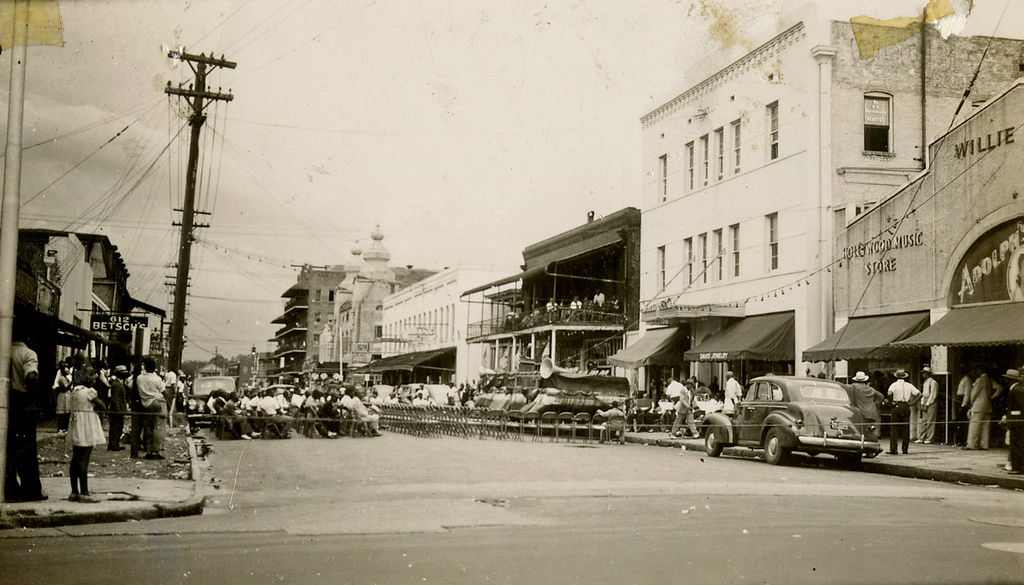
Prior to desegregation, West Ashley Street was a bustling African American nightlife district. Many businesses featured barbecue on their menu.
A popular menu item just after World War II was the rib sandwich, which consisted of three or four ribs served between slices of bread with slaw and a little barbecue sauce. Served with the bones in, the sandwich was meant to be pulled apart with the fingers and eaten.
The rib sandwich is a popular menu item at legacy African American barbecue restaurants, including, Holley’s BBQ. Established by Jack Holley in 1937, Holley’s BBQ is Jacksonville’s oldest and longest continuously operating restaurant. Located at 3604 Moncrief Road, Holley’s is said to be the place where curly fries were invented!