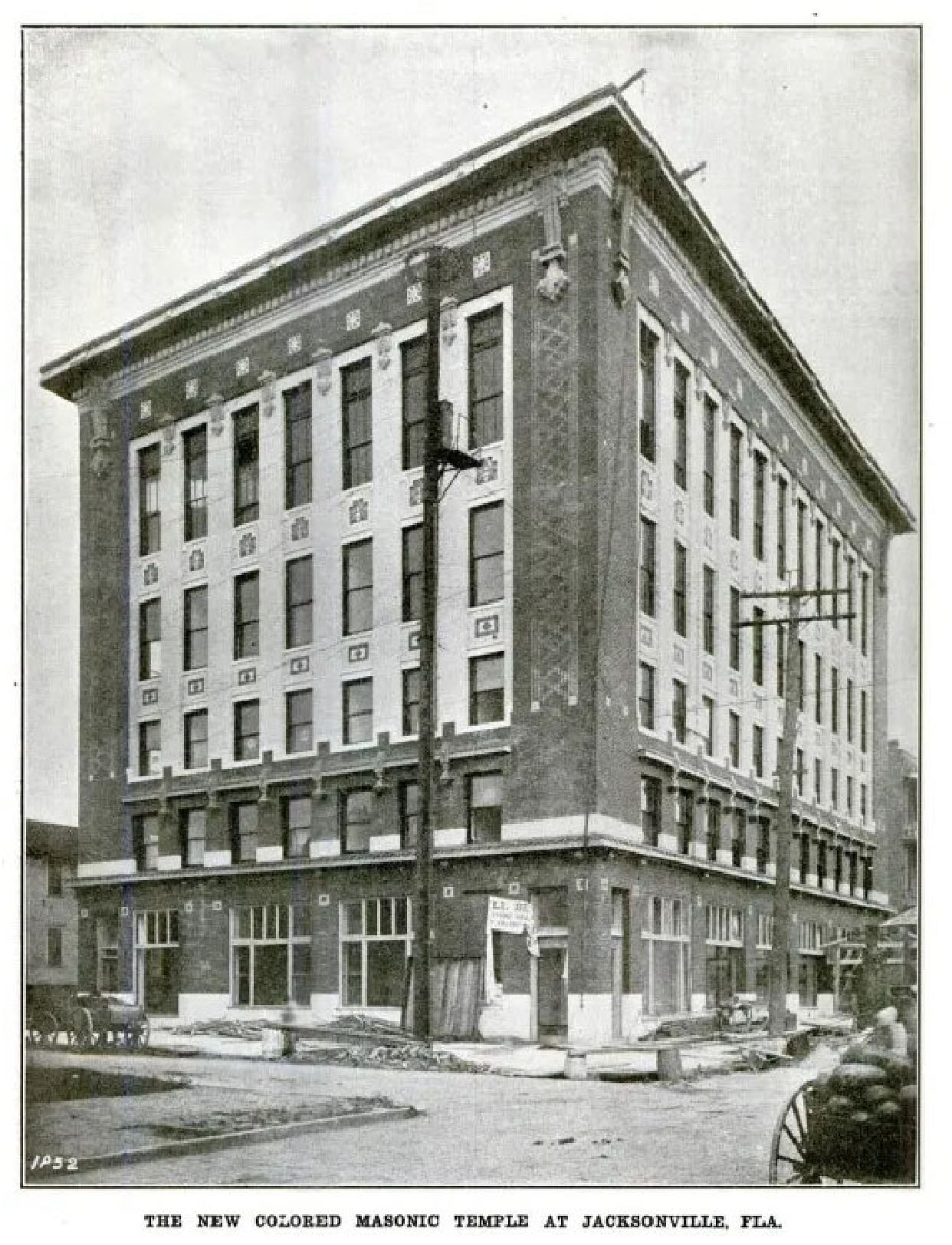
Completed in 1916, the Masonic Temple has served as the focal point for Jacksonville’s Black community’s commercial and fraternal activities for decades. The building was designed by local architects Victor E. Mark, and Leeroy Sheftall with John Anderson Lankford consulting. Known as the “Dean of Black architecture,” Lankford was the first professionally-licensed Black architect in Washington, D.C. who specialized in church, fraternal, and school designs along with residential commissions in Black communities throughout the country and South Africa.
Designed as a mix of Prairie and Chicago School architectural styles, the Masonic Temple was partially financed by the National Negro Businessmen League to provide office space for Black insurance agents, dentists, doctors, attorneys, newspapers, and other businesses in the city.
The building featured retail at street level, office space on the second and third floors, and the top floors were occupied by the Grand Lodge.
Ground floor tenants included: Anderson Tucker & Company, Jacksonville’s second Black-owned bank in 1914, Pedro Mendez Cuban Tailor Shop, and the law office of Leander Shaw, Jr. Shaw became the first Black chief justice of the Florida Supreme Court in 1990. Second floor tenants included Daniel Webster Perkins, Esq. and Viola Muse. D.W. Perkins, also known as “The Colonel,” successfully argued the landmark case before the Florida Supreme Court that allowed African Americans to serve on juries. His nephew, Paul C. Perkins, Sr. Esq., served as co-counsel with Thurgood Marshall and Jack Greenberg of the NAACP Legal Defense Fund, representing the Groveland Four case in Lake County in 1951. A hairdresser, Viola Muse also worked with Zora Neale Hurston for the Negro Writers Unit of the Federal Writers Project in 1936 and 1937. Tenants on the third floor included the Jacksonville branch offices of the Atlanta Life and North Carolina Mutual Life Insurance companies prior to World War II.
The third, fourth, and fifth floors housed the most important Masonic offices and Grand East, a 900-seat auditorium where the community met for events and to discuss various business and political issues. This included nightly sermons during the 1920s by Princess Laura Adorkor Kofi, then associated with Marcus Garvey’s pan-African movement, Brotherhood of Sleeping Car Porter (BSCP) meetings led by labor union leader Asa Philip Randolph, and Civil Rights Movement meetings by the NAACP during the 1960s.
The Most Worshipful Union Grand Lodge of Florida was established June 17th, 1870 during Reconstruction. Founding members were free people of color, former enslaved people and veterans of the United States Colored Troops. Over 1000 of those members held political office shaping the social construct in Florida. The building was designated to the National Register of Historic Places in 1980.