OLD STANTON SCHOOL
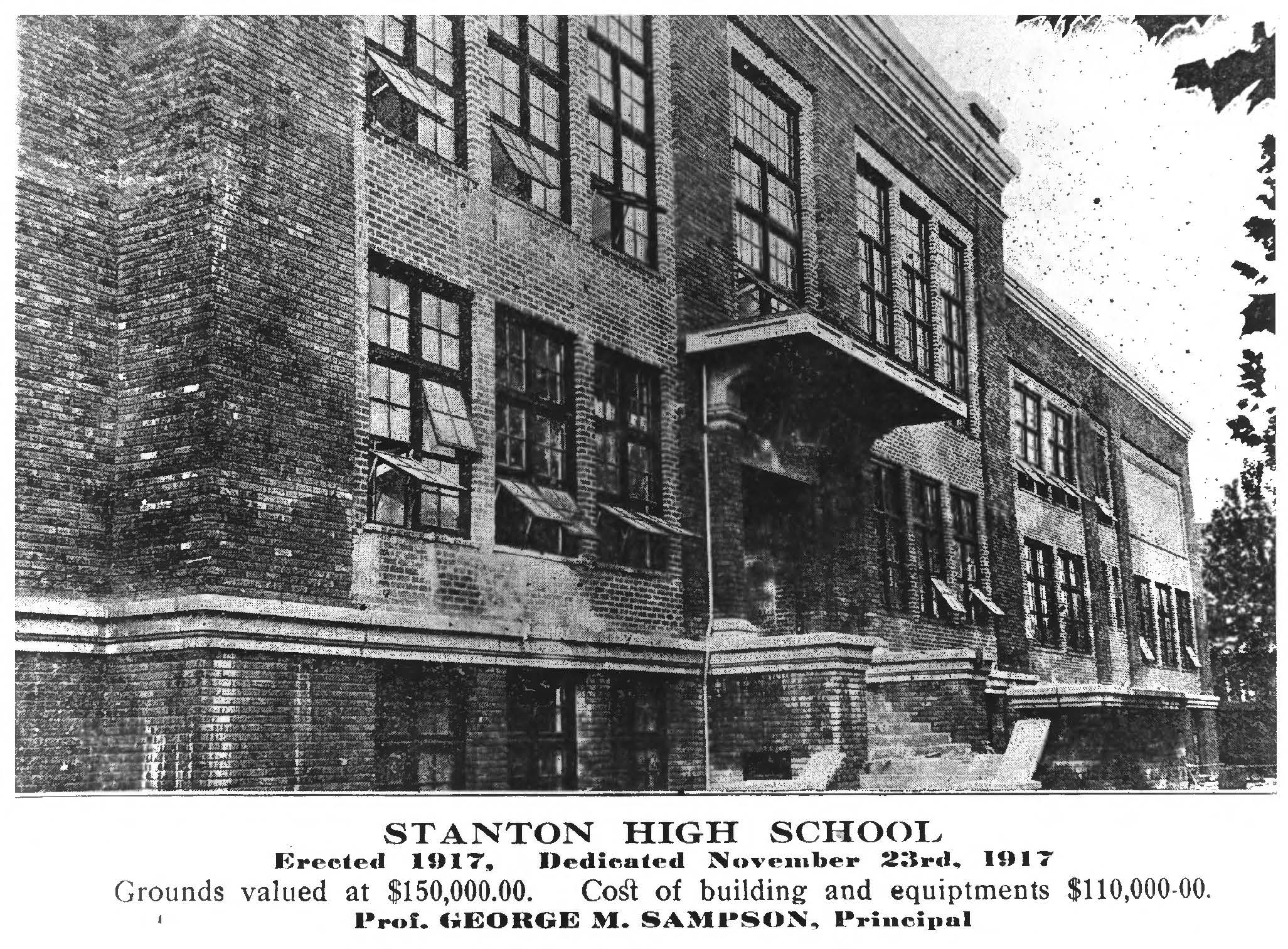
An academically renowned public high school, Stanton is consistently rated as one of the top high schools in the nation. Financed through the aid of the Freedmen’s Bureau and constructed on property once owned by Governor Ossian B. Hart, Stanton was the first school of education for Black children in the State of Florida when it opened on April 10, 1869. The school was named in honor of General Edwin McMasters Stanton, President Abraham Lincoln’s Secretary of War. Stanton was an ardent champion of human rights and an advocate of free formal education for African American children.
In 1877, President Ulysses Grant visited the school during a tour of Florida. During the visit a six-year-old student named James Weldon Johnson raised his hand from the crowd and Grant shook it. Johnson would go on to become the school’s principal in 1894, expanding it to become the only high school for African Americans in the city.
On February 12, 1900, “Lift Ev’ry Voice and Sing” was first performed at five hundred children at Stanton for Booker T. Washington in celebration of President Abraham Lincoln’s Birthday. Written as a poem by James Weldon Johnson and composed by John Rosamond Johnson, the song was later adopted by the National Association for the Advancement of Colored People as the Black National Anthem.
The original Stanton school was destroyed in the Great Fire of 1901 and its replacement was very shoddy. In 1915 the Duval County School Board planned to destroy the Stanton school and replace it with smaller schools throughout the city. The Stanton Board of Trustees filed an injunction which resulted in one of the first civil-rights litigation cases in Jacksonville. The Stanton school was rebuilt and opened its doors in 1917.
This structure was used as a junior high school in 1953-1954. In August 1954, it was converted into Stanton Vocational High School and functioned as a vocational center until 1971. Civil Rights leaders Dr. Mary McLeod Bethune, Miss Eartha M.M. White, Rutledge Pearsona, and Sallye Brooks Mathis are a few of the many important individuals associated with the building.
WEST ASHLEY STREET
Locally known as Uptown, West Ashley Street between Broad and Davis Streets was the major entertainment mecca for Florida’s Black community prior to desegregation. Built on the northwest corner of this intersection in 1909, the Colored Airdome was said to have been the largest theater exclusively for Black people in the South. The first published account of blues on a public stage occurred at the Airdome on April 16, 1910 by John W. F. Woods, a ventriloquist comedian-turned-singer. The Indianapolis Freeman wrote of Woods’s ventriloquism performance where his dummy, “Little Henry,” sang the blues in a drunken act.
New venues opened during the 1920s and ‘30s: the Knights of Pythias Hall, Frolic, Roosevelt, and Strand Theatres. National touring acts Walter Barnes, Cab Calloway, Duke Ellington, Louis Armstrong, and Erskine Hawkins performed at the Knights of Pythias during the 1930s.
By the 1940s, West Ashley Street was one of the most developed Black entertainment districts in the country, leading to its nickname, “Harlem of the South.” Popular destinations included: the Lenape Bar, Wynn Hotel, Manual’s Tap Room, El Chico, and Hollywood Music Store. West Ashley Street played a significant role in the careers of many jazz and blues musicians, including: Ma Rainey, Jelly Roll Morton, Blind Blake, Walter Barnes, Ray Charles, James Brown, Charlie Hoss Singleton, and Teddy Washington.
Even after the Civil Rights Act in 1964, Ashley Street continued to remain a popular entertainment destination until the mid-1970s. A target of the City of Jacksonville’s River City Renaissance urban renewal program, most buildings on West Ashley Street were razed during the 1990s. However, West Ashley Street’s musical and cultural contributions survive.