Council President Anna Brosche introduced legislation to the Jacksonville City Council to appoint a Task Force on Civil Rights History in February 2018, which was passed unanimously upon introduction. The Task Force undertook an in-depth review of Jacksonville’s history with regard to events, persons, places, themes and causes related to America’s civil rights movement and suggest ways that persons, places and events important to the national movement that have connections to Jacksonville can be properly recognized and explained for the education and benefit of all our local citizens and for visitors to Jacksonville who may be unaware of the City’s important role in the civil rights movement. This Task Force timeline is a narrative chronology of significant racial milestones and organized civil rights efforts led in Jacksonville to significantly end racism, racial discrimination based on skin color, and gain equal rights under the law for Jacksonville’s Black citizens.
1865 Emancipation was proclaimed in Tallahassee on May 20, 1865, 11 days after the end of the Civil War. For this reason, Emancipation Day is traditionally celebrated on May 20 in Florida.
1866 Bethel Baptist Institutional Church splinters along racial lines. Whites leave, intending to take the name, but courts rule in favor of Bethel’s Black members.
1866 The African Methodist Episcopal Church founded Edward Waters University, the oldest historically Black college in Florida.
1869 Stanton Normal School, named for Edward McMasters Stanton, the second Secretary of War under Lincoln, opens its doors. It’s the first public school for Black children in Florida.
1869 William T. Garvin and Cataline B. Simmons become the first Black city council members for Jacksonville. Between 1869 and 1907, 110 African American men served in public office in the Town of LaVilla, City of Jacksonville, and Duval County.
1873 Joseph E. Lee moves to Jacksonville where he’s admitted to the Florida Bar to become the first Black attorney in Jacksonville. Lee served in the Florida House of Representatives from 1875 to 1879 and the Florida Senate from 1881 to 1882.
1899-1901 Black businessmen Charles Manigault, John Wetmore, and George Ross are elected as the last Black Jacksonville City Council members until the 1960s.
1900 Manhattan Beach opens. It is considered Florida’s first African American beach resort, and the only beach open to Black patrons until the 1930s.
1900 James Weldon Johnson writes “Lift Ev’ry Voice and Sing,” which his brother John Rosamond Johnson sets to music. The song later becomes known as the “Negro National Anthem.”
1901 Reverend E.J. Gregg, E.W. Latson, Abraham Lincoln Lewis, A.W. Price, Dr. Arthur W. Smith, J.F. Valentine and Reverend John Milton establish the Afro-American Life Insurance Company (“the Afro”), to provide affordable health insurance and death benefits for the Black community.
1901 After the Great Fire of 1901, the Duval County School Board hires Richard Lewis Brown, the city’s first Black architect. In the next decade, he constructs several new schools for which no architect is recorded.
1902 Sylvanus H. Hart opens Jacksonville’s first Black-owned bank, the Central Trust and Investment Company.
1905 Black Jacksonville attorney, Judson Douglas Wetmore, challenges the city’s ordinance mandating racial separation on streetcars. The Florida Supreme Court upholds Wetmore’s legal victory, but the city soon modifies the ordinance to overcome the legal basis for Wetmore’s suit and reimplements streetcar segregation.
1915 May Lofton Kennedy becomes the first Black public librarian in Jacksonville. In 1918, Kennedy becomes the first Black librarian in the Library of Congress.
1916 Bound for the Promised Land by Jacksonville poet Matthew Ward originally published in the Chicago Defender leading to the Great Migration. One of the largest movements of people in United States history, approximately 6 million Black people move from the American South to Northern, Midwestern, and Western states between World War I and the 1970s.
1917 Under the leadership of Eartha M.M. White, Oakland Playground, the first city park opened specifically for Black citizens.
1918 Florida Dwight is appointed the city’s Supervisor of Recreation for Negroes and becomes a champion of Jacksonville’s youth.
1920 Eartha White leads voter registration drives to register Black women. She faces resistance from the Ku Klux Klan, and based on election-day counts, estimates that 3,000 to 4,000 Black voters were turned away from their chance to vote. Two years later, she becomes the Florida director of the National Anti-Lynching Committee and pushes for anti-lynching legislation.
1922 Norman Studios begins operation, making feature-length films and shorts in which Black actors star in roles that depict real storylines instead of stereotyped minstrel characters.
1922 South Jacksonville Grammar School opens for Black children in the Southside neighborhood. Douglas Anderson leads the school’s free bus transportation service. In 1945, the school board renames it the Douglas Anderson School.
1925 A. Phillip Randolph, organizes the Brotherhood of Sleeping Car Porters, the first Black labor union, and seeks a labor contract with the Pullman Company. He later earns the moniker “Father of the Modern Civil Rights Movement.”
1926 A. L. Lewis builds Lincoln Golf and Country Club in Northwest Jacksonville for Blacks.
1929 E. L. Weems, first licensed Black photographer in Jacksonville, opens his first studio, designing his own method of colorization before color film was invented. In business for nearly 50 years, Weems becomes the primary photographic chronicler of Black life in Jacksonville.
1935 A. L. Lewis develops American Beach, in Nassau County, the only beach for Black people in the Jacksonville area.
1941 Mary White Blocker files suit against the Duval County Board of Public Instruction for equal salaries for Black teachers. The court’s 1942 ruling reads “The defendants, the Board of Public Instruction of Duval County Florida and W. Daniel Boyd as the superintendent shall apply a single salary schedule without discrimination because of race or color.”
1945 Reverend Dallas Graham attempts to register as a Democrat, though the Democratic Party in Jacksonville accepts only white voters. Black attorney D.W. Perkins challenges the party, and U.S. Circuit Judge Bayard B. Shields rules that in Graham’s favor. The Democratic Party files an appeal, but the decision is upheld by Judge Mites W. Lewis.
1947 The Jacksonville Urban League is founded.
1951 Eric O. Simpson founds The Florida Star, now Northeast Florida’s oldest Black newspaper.
1951 Stetson Kennedy and other writers release “We Charge Genocide: The Crime of Government against the Negro People” at U.N. meetings in Paris on behalf of the Civil Rights Congress.
1952 Marian Anderson sings to a racially integrated audience at the Old Duval County Armory after refusing to sing to segregated audiences. Anderson’s Jacksonville and Miami shows are the first integrated concerts in Florida since Reconstruction.
1953 Henry “Hank” Aaron, Horace Gamer, and Felix Mantilla integrate baseball’s Minor Leagues when signed to the Jacksonville Braves, who played at Durkee Field.
1956 Postal clerk Rudolph Daniels initiates a United States Postal Service inspection of Jacksonville’s segregated facilities and orders all US Postal facilities desegregated.
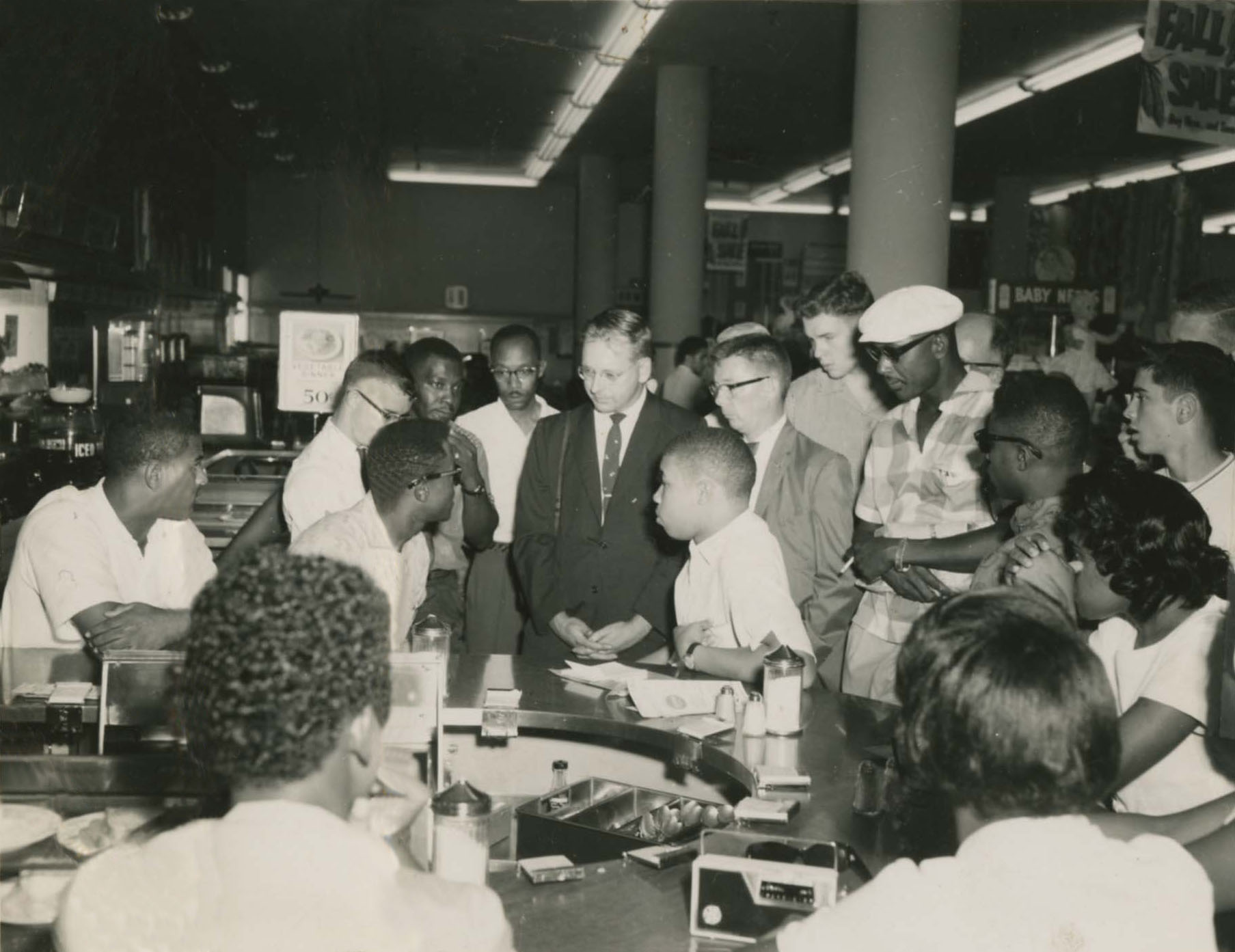
1960 Jacksonville Youth Council NAACP members, led by Rodney L. Hurst, Alton Yates, and Marjorie Meeks and more than 80 mostly high school students, conduct non-violent sit-in demonstrations to protest segregated lunch counters. The adviser of the Youth Council is Rutledge Pearson who would later become president of the Jacksonville Branch NAACP, the President of the Florida State Conference of Branches of the NAACP, and a member of the NAACP’S National Board of Directors.After demonstrating for two weeks, on August 27, 1960 more than 200 White men attacked the students with ax handles and baseball bats. As a result of biracial committee meetings, an agreement is made to integrate downtown lunch counters in 1961.
1960 Jacksonville NAACP Legal Counsel, Earl Johnson, files suits on behalf of seven Black parents and fourteen children, charging the Duval County School Board with operating a system of racially segregated schools. The case is known as Braxton v. Board of Public Instruction of Duval County, Florida.
1960 Black business owner Frank Hampton files suit with a group of Black citizens demanding Jacksonville desegregate municipal golf courses. The suit is amended to include the Gator Bowl, Civic Auditorium, Wolfson Park, the Jacksonville Zoo, swimming pools, and parks and playgrounds. Another suit is filed requiring desegregation of the Duval County Courthouse, Duval Hospital, beaches, county jail, and prison farm. To avoid the lawsuits, County Commissioners agree to the desegregation of those facilities.
1961 Adrian Kenneth “Ken” Knight hosts the Ken Knight Show to broadcast “the talents of our people in music and other forms of entertainment, but, also, present to the viewing public other fields of achievement by Negroes,” according to Knight.
1962 Federal Judge Bryan Simpson rules that the Duval County School Board must develop a plan for ending public school segregation. The School Board plan approved by Judge Simpson allows for the integration of first and second grades in 1963 with a different grade level added each year until in full compliance with the court order.
1963 For two hours after his victory NASCAR refuses to recognize Wendell Scott as the winner of the Jacksonville 200 at Jacksonville’s Speedway Park to avoid having 5,000 white fans see a Black driver hold the trophy and perform the victory ritual of kissing the beauty queen, who is white.
1963 A. Philip Randolph and Bayard Rustin organize the March on Washington for Jobs and Freedom, where Martin Luther King delivers his famous “I Have a Dream” speech.
1964 The Ku Klux Klan bombs the home of Iona Godfrey, mother of Donal Godfrey, a Black first grader, for attending previously all-white Lackawanna Elementary School. There are no injuries. One Klansman is sentenced to seven years, one acquitted, and four other Klansmen released due to a mistrial.
1964 Frustrated with the School Board’s slow pace in following the desegregation order, the NAACP requests Black students to strike for three days, beginning on December 7, 1964. On the first day, 17,000 black students stayed home from school. Within three days, 31,000 students participated in the strike.
1964 Johnnie Mae Chappel, a mother of 10, is shot and murdered as she walks along New Kings Road by four white men. Of the four men in the car, only J.W. Rich is charged. He serves three years.
1964 Five days before the Beatles are to play Jacksonville, they release a statement protesting segregation in the city’s municipal facilities and refuse to play unless the audience is de de-segregated. John Lennon says, “I’d sooner lose our appearance money” than play to a segregated audience. The City relents and opens the concert to all.
1967 Attorney Earl Johnson, Sallye Mathis, Mary Singleton, and Oscar Taylor are the first Black City Council members since 1907. Sallye Mathis and Mary Singleton are also the first women ever elected to City Council. Charles E. Simmons, Jr. is elected to the City Civil Service Board after having been appointed to the position in 1966.
1969 A white cigarette salesman shoots at a group of young Black men who are near his truck on Florida Avenue, hitting Buck Riley in the leg. The incident leads to riots and Dr. Arnett E. Girardeau, Chairman of the Community Urban Development Council, requests Mayor Hans Tanzler to have the Jacksonville Community Relations Commission investigate. A special committee is formed, but suggestions from the special committee’s report are never implemented.
1969 Wendell P. Holmes, Jr. is elected to the Duval County School Board, becoming the first Black school board member in Florida.
1971 A police officer shoots and kills Black teenager, Donnie Ray Hall, on suspicion of stealing an automobile. 300 black demonstrators under the local NAACP chapter picket the Duval County Courthouse and then small groups loot and burn buildings along Florida Avenue for several days. The Community Urban Development Council, under Dr. Girardeau, document cases of police brutality and harassment and provide this information to Governor Reuben Askew. After a police officer was shot and killed with another one wounded, a grand jury investigated the recent incidents, concluding that the Sheriff’s Office demonstrated proper restraint, but recommended better communication between the police and Black community.
1971 Eddie Mae Steward, on behalf of her daughter, Alta Oveta Mims, successfully sues the Duval County School Board over continued segregation. Mims v. Duval County School Board alleges the county maintains 113 totally segregated schools—89 white and 24 Black—and that the white schools are staffed by white personnel and Black schools are staffed by Black personnel. Steward becomes president of the Jacksonville NAACP in 1972.
1972 Mary L. Singleton, one of the first Black City Council members since Reconstruction is elected to the Florida House of Representatives, becoming the first Black legislator from North Florida since Reconstruction.
1976 Dr. Arnett Girardeau is elected to the Florida House of Representatives where he advocates for prison reform and social service issues and leads the State of Florida to withdraw investments from South Africa in protest against Apartheid. In 1982, he becomes the first Black person to serve in the Florida Senate from Northeast Florida since Reconstruction.
1989 The Jacksonville Black History Calendar is created under the leadership of Dr. Brenda Robinson Simmons and Ms. Clovia Russell. The typesetting was done by Mrs. Yvonne Jones. The calendar chronicles Black life, history, culture and contributions. The publication wins the Jacksonville Historic Commission’s Historic Preservation Award and in 2016 and is digitized in the Jacksonville Public Library.
1990 Attorney Leander Shaw becomes the first Black chief justice of the Florida Supreme Court. Shaw had been appointed a judge of the Florida Industrial Relations Commission in 1972 and appointed to the First District Court of Appeal in 1979.
2011 Alvin Brown is elected, becoming the first African American mayor of Jacksonville
2013 The Duval County School Board votes to support the renaming of Nathan Bedford Forrest High School, named in 1959 for a Confederate general and first Grand Wizard of the Ku Klux Klan. After Forrest students voted to change the name, the students selected to rename Forrest High School to Westside High School and select the Wolverine as the mascot. The school board ratified their choice.
2014-2017 James Weldon Johson, A. Philip Randolph, Sallye B. Mathis, Rutledge Pearson, Earl M. Johnson and Arnett Girardeau are inducted into the Florida Civil Rights Hall of Fame.