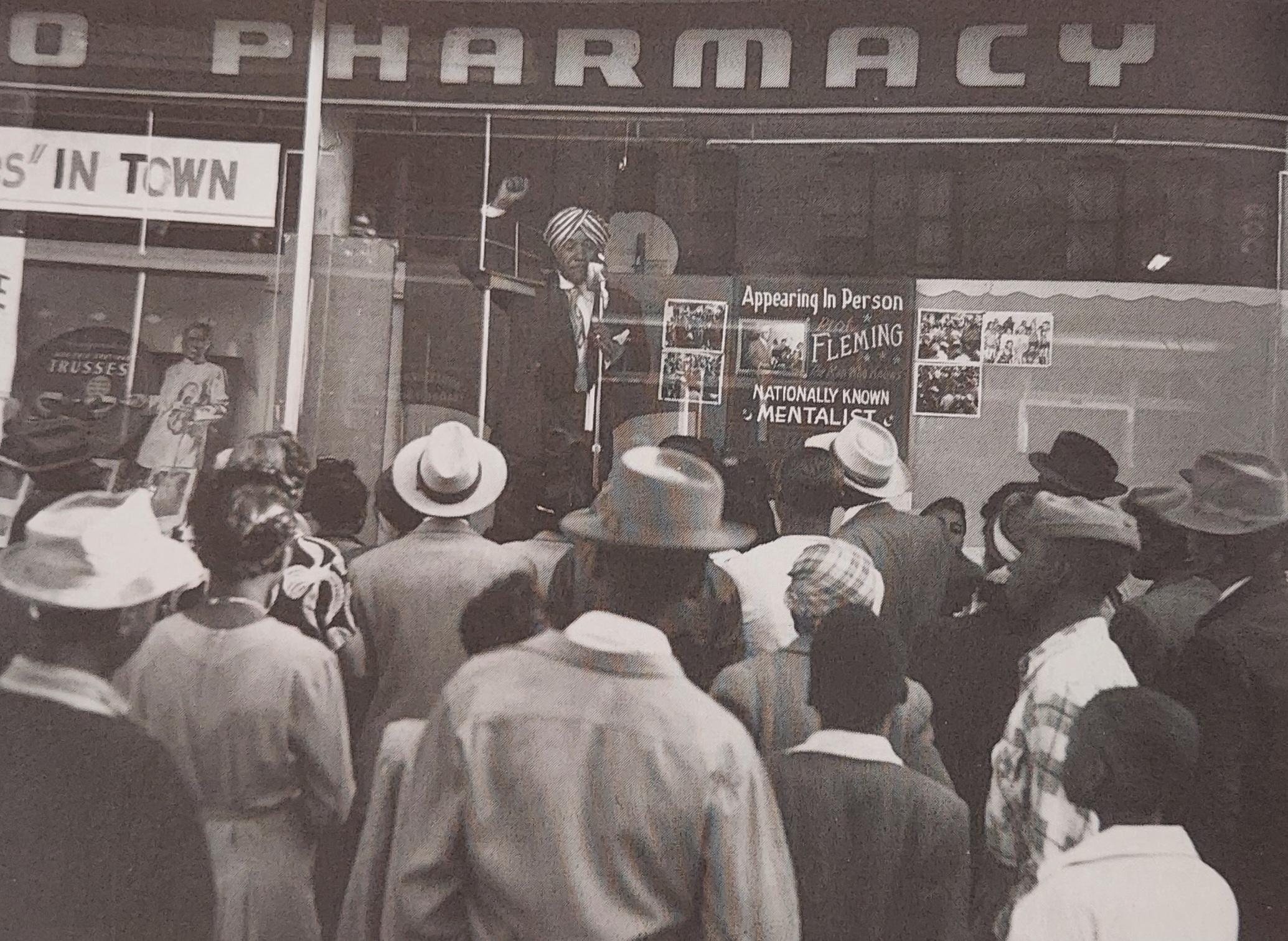
Known as Second Street prior to LaVilla’s 1887 annexation into Jacksonville, Davis Street developed into an important corridor lined with hotels, restaurants, theaters, and retail businesses following the Great Fire of 1901.
In 1902, the North Jacksonville Street Company began operating a streetcar line on Davis Street. The Black-owned streetcar line became known as “The Colored Man’s Railroad.” Connected by streetcar, the African American neighborhoods of Sugar Hill, Moncrief Park, and Durkeeville were established along the Davis Street corridor. Today, this early 20th century expansion of LaVilla is now recognized as the neighborhoods of Northwest Jacksonville.
Businesses and institutions operating on Davis Street included: Nick’s Pool Parlor, Flagler Hotel, Boston Chop House, Ritz Theatre, and the Cookman Institute. In 1923, the Cookman Institute merged with Dr. Mary McLeod Bethune’s Daytona Literary and Industrial Training School for Negro Girls to become Bethune-Cookman University in Daytona Beach. After 1950, Davis Street declined as it became a central target of local urban renewal efforts, including the construction of Interstate 95 and the urban renewal of the nearby Sugar Hill and Hansontown neighborhoods during the 1960s and 1970s.
In 1993, the City of Jacksonville approved the River City Renaissance urban renewal program, which resulted in the wholesale demolition of a 50-block area of LaVilla bounded by Interstate 95 and State, Broad and Forsyth Streets. Most current structures located on this stretch of Davis Street, including the LaVilla School of the Arts, were built because of the River City Renaissance project.