The original settlement of Hansontown was the brainchild of Daniel Dustin Hanson, a surgeon with the 34th Regiment, U.S. Colored Infantry. Hanson acquired a large tract of land northwest of Jacksonville in 1866 where he intended to develop a communal farming community for Black Civil War veterans and the formerly enslaved. Here, they would grow and sell crops, allowing them to pool their earnings towards land purchases. Hanson’s dream never materialized but a community was born.
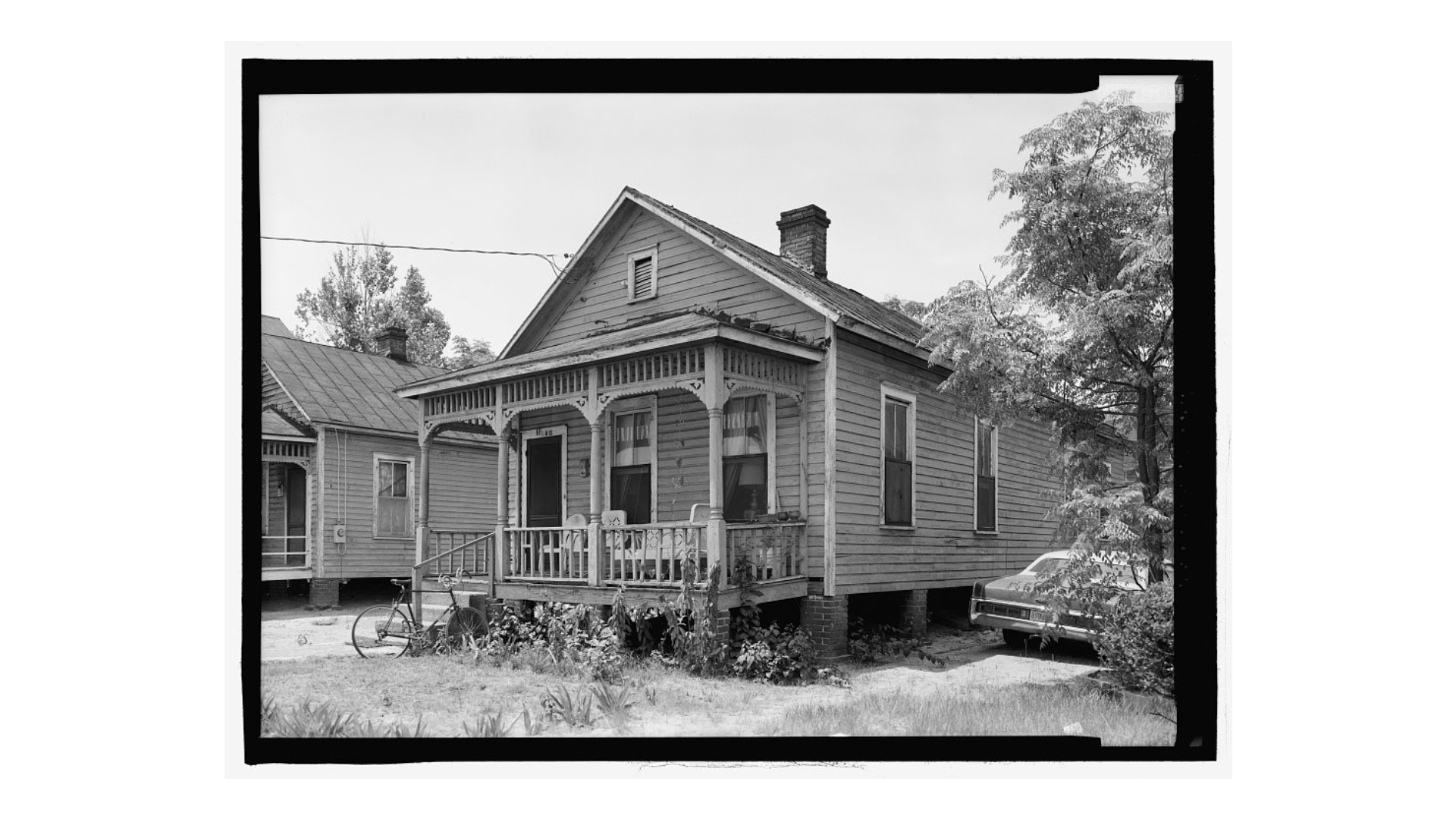
Hansontown was a working-class African American community characterized by small frame shotgun-style housing and unpaved streets. It quickly became an easy target for the city’s early urban renewal programs. The neighborhood largely met its demise in 1974, when plans were approved to replace 21 acres of the community acquired with local and federal urban renewal funds, with the present-day downtown campus of Florida State College of Jacksonville. The $11 million campus was officially dedicated on August 15, 1977.
Historic buildings north of Union Street, including the Whetstonian, Fraternal Order of Odd Fellows Hall, and St. Philips Episcopal Church are remnants of one of Jacksonville’s earliest Gullah Geechee communities.
Located at 801 North Jefferson Street, the Whetstonian was built in 1927. Featuring two upstairs apartment units, the ground level storefronts were occupied by a variety of businesses, including The Apothecary Shop by Theo M. Christopher and Chitlin’ Circuit era juke joints such as Bill’s Bar-B-Q and the Stardust Club. It was later owned by Walter Whetstone. Whetstone spent a lifetime collecting and storing artifacts from LaVilla’s past on the property. According to Whetstone, “If Smithson can have his Smithsonian, then Whetstone can have the Whetstonian.”
According to James Weldon Johnson, Odd Fellows lodges were made up of white-collar workers, in contrast to the local Masonic lodges, which recruited largely from stevedores, hod carriers, lumber mill workers, and brickyard hands. In Hansontown, the Odd Fellows Hall was located on the southeast corner of State and Pearl Streets. At Odd Fellows, a young Cookman Institute class valedictorian, A. Philip Randolph, gave a speech he called “The Man of the Hour” in 1907. Randolph would later organize the Brotherhood of Sleeping Car Porters, the first predominantly African American labor union, as well as the March on Washington in 1963.
In March 1912, the Odd Fellows Hall hosted a banquet for Booker T. Washing, co-founder of the National Negro Business League and Tuskegee Institute. Noted anthropologist Zora Neale Hurston also performed at the Fraternal Order of Odd Fellows during her time in Jacksonville.
Nearby, St. Philips Episcopal Church was organized in 1882 to accommodate the growth of Black Episcopalians in the area. The mission was named for Saint Philip. According to the Acts of the Apostles, Saint Philip was a Black man called by Jesus to follow him.
The sanctuary at the intersection of Union and Pearl Streets, was designed by Henrietta Cuttino Dozier (1872-1947). Dozier is recognized as the first woman architect in Florida and Georgia. To overcome discrimination, she was known to disguise her gender with various male-sounding or gender-neutral names such as Cousin Harry and H.C. Dozier. Under the supervision of William S. Sumter and Dennis Taylor, church members provided free construction labor to complete the church building in 1914.