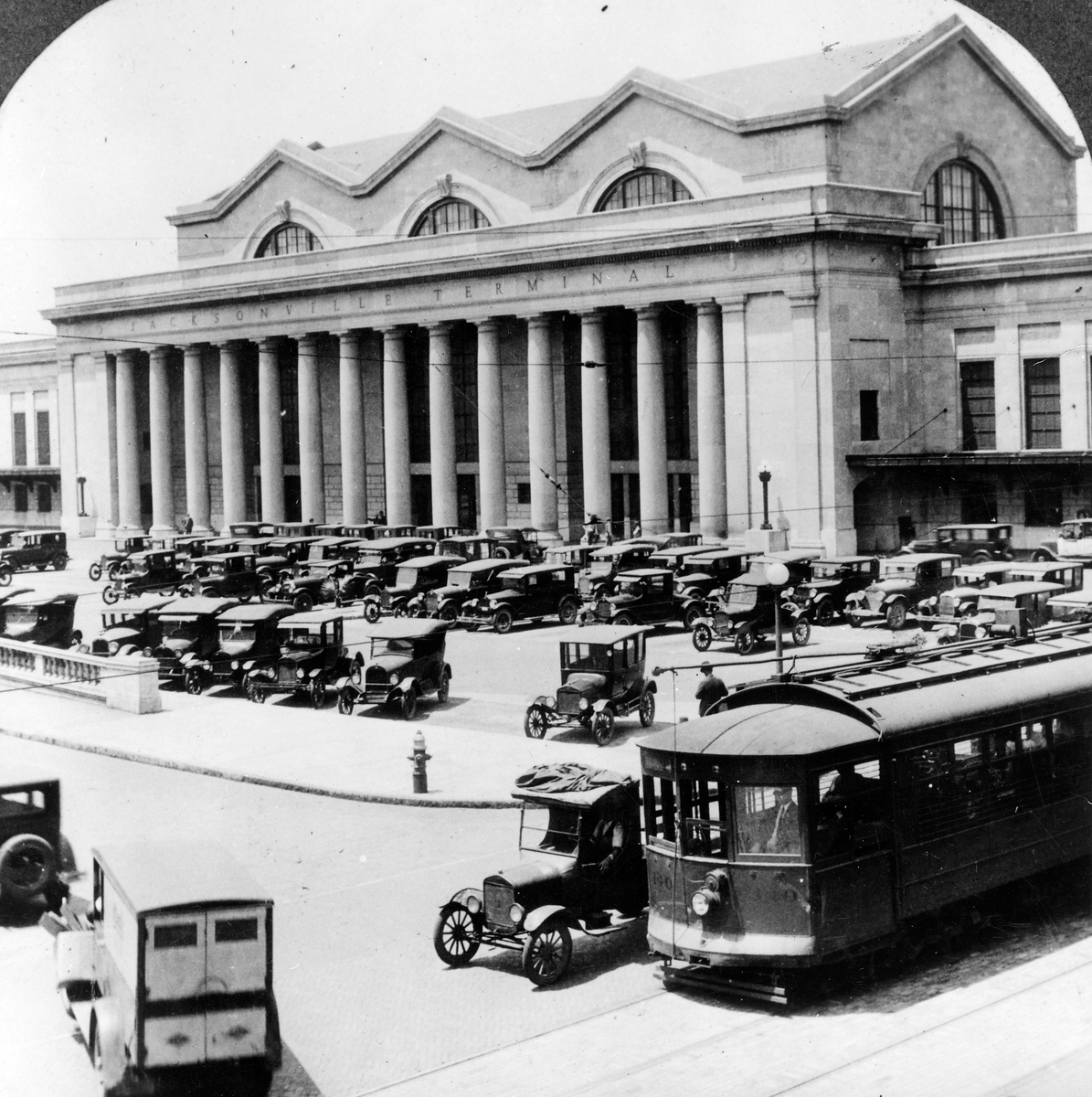
The Jacksonville Terminal, which opened on November 17, 1919, was organized by Henry Flagler in the 1890s to accommodate the volume of visitors brought to Florida through Jacksonville. The terminal was designed by New York architect Kenneth M. Murchison, whose Neoclassical Revival–style design featured a 180-foot long façade of 42-foot tall Doric columns. The main waiting room contained 75-foot cathedral-like vaulted ceilings and the black waiting room had a lower, more detailed coffered ceiling. Over 2,000 people were employed to operate the large facility, making it the city’s second-largest employer at the time.
On opening day, the terminal handled more than 110 trains and 20,000 passengers. Traffic peaked in 1944 when 40,000 trains passed through the terminal, carrying nearly 10 million passengers. The subway became the “Gateway to Florida” for millions of passengers, including the Duke and Duchess of Windsor in 1941 and every US president from 1921 until the terminal’s closure in 1974. The terminal was closed in 1974 due to high maintenance costs, low rail travel, and in 1976, it was placed on the National Register of Historic Places. On November 23, 1983, the Jacksonville City Council approved $37.2 million to convert the terminal into the Prime F. Osborn III Convention Center, named for the former CSX chairman who worked to rescue the terminal from demolition.