Historically, the land we refer to today as Jacksonville is on the traditional homeland and territories of the Timucua people. After forced removal of the Indigenous people, the land was portioned off by the Spanish government to various plantation owners through a series of land grants in the early nineteenth century.
Named after the LaVilla Plantation, LaVilla was platted in 1866 by Francis F. L’Engle and settled by United States Colored Troops, Gullah Geechee, freedmen, and freedwomen. It was incorporated as a town of its own in 1869. L’Engle served as LaVilla’s first mayor and by the time the community was annexed into Jacksonville in 1887, its population had increased to 3,000.
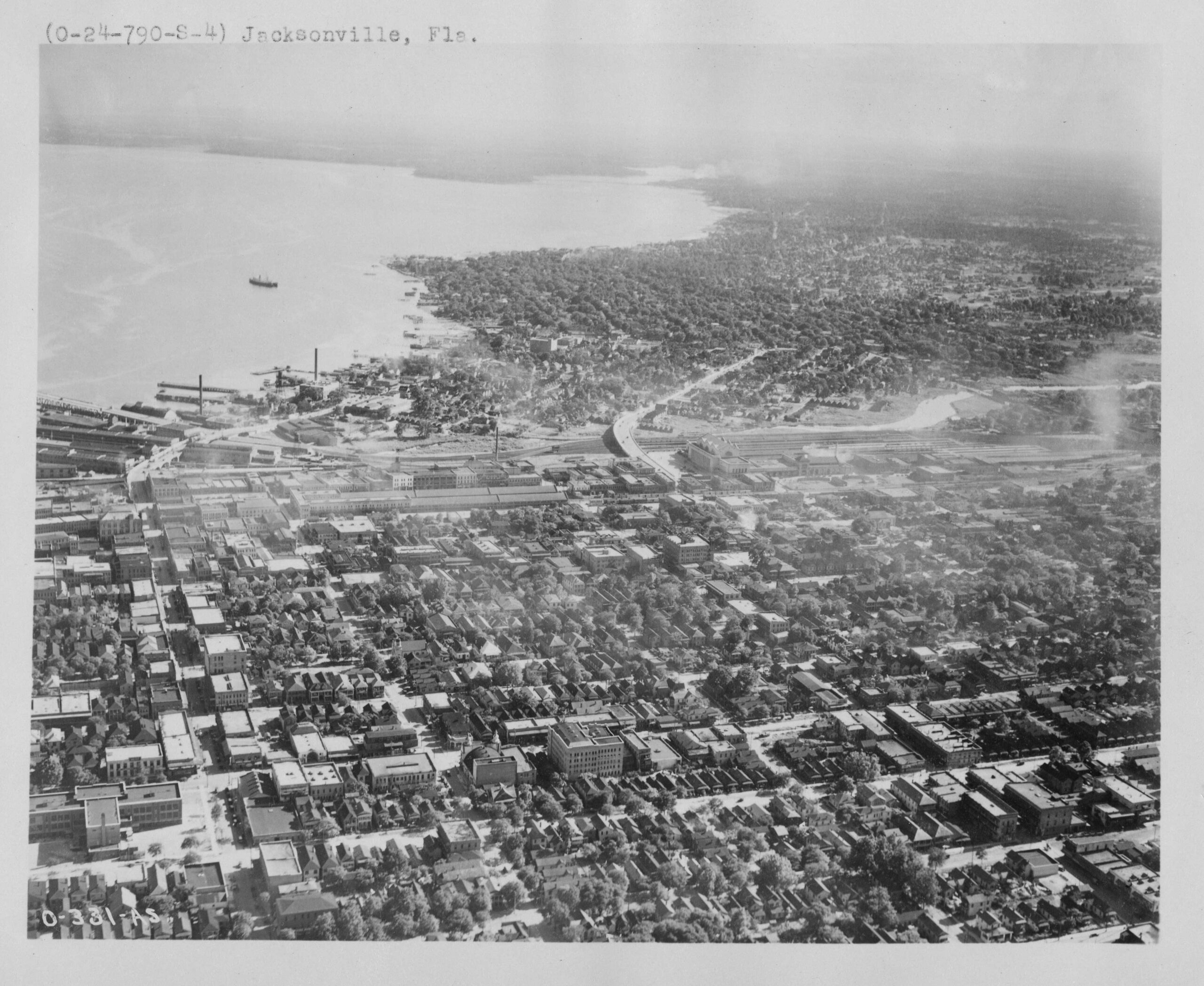
Anchored by Henry Flagler’s Jacksonville Terminal railroad station, LaVilla became a transportation hub and emerged as a major epicenter for ragtime, jazz, and blues during the early twentieth century. Ma Rainey, Ray Charles, Duke Ellington, Ella Fitzgerald, Billie Holiday, and Cab Calloway performed in various concert halls in LaVilla.
LaVilla played a transformative role in what would become known as the Great Migration and became one of several southern communities recognized as a Harlem of the South during the 1940s and 50s. An influential community in the fight for Civil Rights, LaVilla was negatively impacted by the construction of Interstate 95 and urban renewal during the late 20th century.
Today, LaVilla is in a period of rebirth and revitalization.
On this site in 1900, the poem, “Lift Ev’ry Voice and Sing,” was written and set to music by LaVilla natives and brothers, James Weldon and John Rosamond Johnson. The song has been nationally recognized as the Negro National Anthem for more than a century.
The LaVilla: Lift Ev’ry Voice and Sing Trail highlights the legacy of this culturally significant community and pays homage to the instrumental role it has contributed to the physical, cultural, and social development of Jacksonville and the nation as a whole.
LAVILLA TIMELINE
1842 – Rev. James McDonald acquires the tract and establishes a plantation.
1851 – Rev. Joseph S. Baker acquires the McDonald plantation. Son, J. McRobert Baker renamed the plantation LaVilla.
1863 – In March 1863, the 33rd U.S. Colored Troops regiment arrive in Jacksonville with Harriet Tubman and Susie King Taylor, the country’s first Black Army nurse, to secure Unionist sentiment and attract enslaved people to be recruited into the regiment.
1865 – Emancipation proclaimed in Tallahassee on May 20, 1865.
1866 – Attorney Francis F. L’Engle plats the community of LaVilla. LaVilla was later incorporated as a town in 1869.
1868 – Stanton, Florida’s first official school for African Americans opens.
1870 – Seventy percent of LaVilla’s population was African American, many of whom worked in the city’s booming hotel, lumber, port, building, and railroad industries.
1887 – LaVilla, then Jacksonville’s largest suburb with 3,000 residents, is annexed by the City of Jacksonville.
1900 – James Weldon and John Rosamond Johnson write and compose “Lift Ev’ry Voice and Sing. The Song becomes unofficially known as the “Black National Anthem.”
1901 – The Great Fire of 1901 originates in LaVilla. Fire destroys Jacksonville, leaving 10,000 homeless.
1910 – The first published account of blues singing on a public stage in the United States, occurs at LaVilla’s Colored Airdome on April 16, 1910.
1916 – “Bound for the Promised Land,” written by Jacksonville poet Matthew Ward, is published in the Chicago Defender and influences the Great Migration. More than 6,000 African Americans left Jacksonville between 1916-1917 due to the economic conditions, white militancy, and Jim Crow laws.
1919 – The Jacksonville Terminal opens. Modeled after NYC’s Penn Station, the train station is the largest south of Washington, DC.
1935 – Musician Walter Barnes toured the American South. Establishing his southern headquarters in LaVilla, Barnes used his position at the Chicago Defender to advertise and promote his own tours and other entertainers on the same touring trail. Barnes is later credited as an early originator of the “Chitlin’ Circuit.”
1945 – Ray Charles moves to LaVilla, where he began his professional career at age fifteen.
1958 – The Jacksonville Expressway (Interstate 95) is completed through the heart of the LaVilla community.
1964 – The Civil Rights Act of 1964 is signed into law by President Lyndon B. Johnson, ending Segregation. LaVilla falls into a period of decline.
1993 – The $235 million River City Renaissance urban renewal plan destroys significant portions of LaVilla, east of Interstate 95.
2019 – DIA completes the LaVilla Neighborhood Development Strategy plan.
2026 – The LaVilla Heritage Trail is completed.